
Guides
LinkedIn profile score: what is good and how to raise yours
By Nasir Ali, Co-FounderPublished Updated 10 min read
In short: A LinkedIn profile score is a number that stands in for a question: can the reader you want find you, understand you and trust you in a few seconds? LinkedIn's own meter measured completeness, and its All-Star level meant every main section was filled in.1 Third-party checkers add keyword matching against the jobs you want, and a reader-specific score adds clarity and proof for one audience.2 A good score is one that says every section is present and written for that reader, and the only reliable way to raise it is section by section.
You update your headline, add a certificate, and a tool tells you that your profile went from 62 to 71. It feels like progress. But what does 71 mean? Is it good? Who decided? And would a recruiter in your field, or a founder looking for a freelancer, agree?
Profile scores are useful because they turn a vague feeling ("my profile could be better") into a list of things to fix. They are also easy to misread, because different scores measure different things. LinkedIn's historical profile strength meter, a keyword-matching tool and a reader-specific checker can all give you a number out of 100, and the three numbers do not mean the same thing.
This guide explains what the common scores measure, what "good" looks like in practice, and how to raise your score one section at a time.
What is a LinkedIn profile score?
A LinkedIn profile score is a number, usually out of 100, that summarizes how well your profile meets a set of checks. The checks depend on who built the score, so the first question to ask of any score is "what does it measure?"
Three kinds of scores are common.
- Completeness scores count the sections you have filled in. LinkedIn's own profile meter worked this way, and a patent filed by LinkedIn in 2015 describes a "profile completion score" that assigns a weight to each profile field a member has completed and combines them into one number.3
- Keyword-match scores compare the words on your profile with the words in job posts you choose. Jobscan, for example, asks you to paste at least three job descriptions and then reports a match score built from your headline, summary, experience, skills and education.2
- Reader-specific scores ask a different question: for one audience, does each section exist, say something clear, and give a reason to believe it? This is the approach Enigma Reload takes, and it is the one this guide uses to define "good."
None of these numbers is a ranking. LinkedIn personalizes search results for every searcher, so no score can tell you where you appear for a given query. A score is a diagnostic, not a promise.
What did LinkedIn's own profile strength and All-Star mean?
LinkedIn's profile strength meter was a completeness gauge, and All-Star was its top level, reached when the main sections were filled in. Understanding it helps because most "profile score" advice still descends from it.
In 2012 LinkedIn published a short list of what a complete profile needed: "Add a profile photo," "List all the jobs or positions you've held," "Have 5 or more skills on your profile," "Write a summary about yourself," "Fill out your industry and postal code," "Add where you went to school" and "Have 50 or more connections."4 The same post announced a change in how completeness was calculated, giving more weight to things you control, such as skills, and less to things like recommendations.4
By 2017 LinkedIn wrote that "All-Star status is a thing" and described a completion meter on desktop and mobile that showed how a profile compared and offered quick tips, adding that "the more complete it is, the more you'll stand out."1 The post attached numbers to individual sections: a profile photo "can get you 21x more profile views and 9x more connection requests," a current position "can lead to 8X more profile views," and listing education "will get you 17x more messages from recruiters" if you are not yet employed.1
Two things follow. First, LinkedIn has changed the meter and its math more than once, so you may not see the same level today that you saw years ago.4 Second, the meter never measured quality. A profile with a blurry photo, a one-word headline and an About section that says "Experienced professional" could reach All-Star. Completeness is the floor, not the goal.
Evidence: LinkedIn's patent for a profile completion score describes a system that looks up a weight for each profile field a member has completed and sums those weights into one score; in its worked example, three completed fields worth 17, 10 and 6 points produce a score of 33.3 The score counts what is present. It does not read what you wrote.
Why is completeness not the same as quality?
Completeness tells you that a section exists. Quality tells you whether that section works for a reader. A score that only counts sections can be high on a profile that nobody understands.
Search is one reason this matters more now than it did when the All-Star meter appeared. LinkedIn's engineers describe their newer search systems as semantic: they retrieve and rank results "by meaning rather than token overlap," and they build a unified member summary from profiles, professional content and activity.5 In November 2025 LinkedIn also launched an AI-powered people search that lets members type what they want "in plain language," noting that until then search "has been literal."6
When search reads meaning, a filled-in section with vague text gives the system little to match. "Results-driven leader" is complete. "Operations manager for food distributors, cutting delivery errors with route planning" is useful. Only one tells a reader and a search model what you do.
Competition is another reason. LinkedIn had 1.2 billion members in mid-2025, and a LinkedIn survey reported in January 2026 found that the number of applicants for open roles had doubled since spring 2022, while nearly half of applicants worried about how to stand out.78 In that setting, a profile that is merely complete is average by definition.
What does each kind of score actually measure?
Each score measures a different layer of your profile, so the same profile can earn three different numbers. The table below shows what each layer checks and the question it can and cannot answer.
| Score type | What it checks | Can tell you | Cannot tell you |
|---|---|---|---|
| Completeness (LinkedIn's historical meter) | Whether photo, positions, skills, summary, education, industry and connections are present | Which sections are empty | Whether the text is clear or credible |
| Keyword match (tools such as Jobscan) | Whether words from chosen job posts appear in your headline, summary, experience, skills and education | Which job-post terms your profile is missing | Whether a reader believes you, or how you rank |
| Reader-specific (Enigma Reload's Profile strength) | Whether each of 14 sections exists, is written for your chosen reader and offers proof | What to fix first for that reader | Your position in search, views or job offers |
Source: compiled by Enigma Reload from LinkedIn's profile completeness posts, LinkedIn's profile completion score patent and Jobscan's tool guide.1432
Read a score together with its checklist. The number tells you how far you are from the tool's definition of done; the checklist tells you what to do next.
What is a good LinkedIn profile score?
A good score is one that says every main section is present and written for a specific reader, with at least one piece of proof in the sections that carry the most weight for that reader. On most 100-point scales, that is a score in the 80s or above, with no section flagged as empty.
Here is a practical reading of score bands as they appear on reader-specific checkers. The bands are a guide, not a rule, and not a prediction of results.
- Below 50: Sections are missing or placeholder text is doing the work. Readers cannot tell what you do. Fix the empty sections first.
- 50 to 69: The profile is mostly complete but generic. The headline is a job title, the About section describes you rather than your reader, and experience lists duties without results.
- 70 to 84: The profile reads clearly for one audience. The remaining gaps are usually proof (numbers, recommendations, Featured items) and consistency between sections.
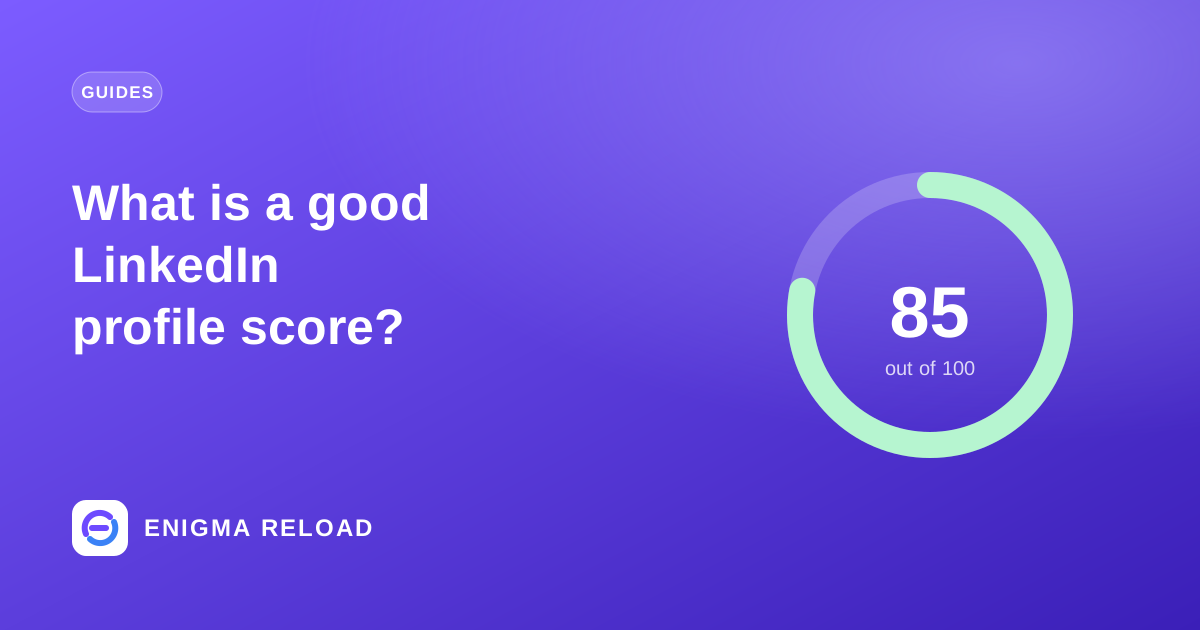
- 85 and above: Every section is present, each is written for the same reader, and the claims are backed by evidence. Enigma Reload issues a verified certificate at this level.
Two cautions. First, a high score for the wrong reader is not a good score. A profile tuned for recruiters can score well and still miss the clients you want, so pick the reader before you chase the number. Second, a profile padded with repeated keywords reads as spam to the person who opens it, so treat a score that rewards keyword counts with care.
How do you raise your LinkedIn profile score section by section?
You raise your score by working through the sections in the order a reader meets them, making each one specific to that reader, and adding proof where you make a claim. The list below follows the 14 sections a full profile check covers.
Photo and banner
Use a recent, well-lit headshot where your face fills most of the frame. LinkedIn's own figures for the effect of a photo are the oldest and the strongest in its advice.1 Make the banner say what you do or who you help; an empty default banner is a missed sentence.
Headline
Start with the standard title your reader searches for, add who you help and the result, and finish with one proof point. A headline that is only a job title is complete but weak. Our guide to LinkedIn headline examples covers the formula in detail.
About
Write it for the reader, not about yourself. Open with the problem you solve, give two or three results with numbers, say who you work with, and end with how to reach you. Keyword-match tools check the About section for relevant skills and measurable results, and a reader-specific check looks for the same things in plain language.2
Experience
For each role, write two to four bullets that pair an action with a result. "Managed a team" is a duty. "Cut onboarding time from 14 days to 6 by rewriting the checklist" is evidence. Fill in dates, titles and company names; tools treat a role with missing fields as incomplete.2
Skills
List the skills your reader uses in job posts and briefs, and keep the top three accurate. LinkedIn found that 70 percent of job descriptions posted in the prior year incorporated concrete skills, even though only 13 percent of recruiter searches used a skills filter.9 That means skills still matter, mostly as words a person reads, not as a filter.
Education, licenses and certifications
Add every degree and the certifications your reader respects. For early-career members, LinkedIn's 2017 advice singled out education as the section that most increased recruiter messages.1
Featured
Pin two to four items that prove your claims: a case study, a portfolio page, a talk, a published post. Featured turns the About section's promises into evidence.
Recommendations
Ask three people who have seen your work to write two or three specific sentences each. Recommendations are the one section you cannot write yourself, which is why they count as proof.
Activity
Post or comment on topics your reader cares about, regularly rather than in bursts. A reader-specific score includes recent activity because a silent profile reads as inactive.
Custom URL, location and contact, languages and projects
Set a clean custom URL, make your location accurate, open at least one contact channel, and list languages and projects if they matter to your reader. These are small, fast fixes that completeness scores have rewarded since 2012.4
Work through the sections in order, rescan, and fix the lowest section next. LinkedIn's Work Change research estimates that by 2030, 70 percent of the skills used in most jobs will change, so a profile check is worth repeating a few times a year rather than once.10
How does Enigma Reload help you raise your profile score?
Enigma Reload is a LinkedIn profile optimizer and score checker for the reader you choose. It reads your own profile through the Chrome extension, which also sees your skills and recent activity, or from your LinkedIn PDF, which covers text only. It then gives you three scores out of 100: Profile strength, Niche and Content. Each shows what is working, what to improve and what to do next.
The Profile strength score covers 14 sections: photo, banner, headline, About, experience, skills, education, licenses and certifications, Featured, recommendations, activity, custom URL, location and contact, and languages and projects. When a section is weak, you get rewrites built from your own profile, including 10 headline styles, About drafts and experience bullets, each with a preview score, plus templates, a banner designer and a headshot check. Reach 85 or more and you can claim a verified certificate.
It does not post, comment or edit anything on LinkedIn, and it does not promise search positions, views or jobs, because LinkedIn personalizes results for every searcher. The service is free during beta.
See how the scan works or get your free score.
Key takeaways
- A profile score is only meaningful next to its checklist: ask what the score measures before you chase it.
- LinkedIn's profile strength meter and All-Star level measured completeness, not quality; its patent describes a score that sums weights for completed fields.13
- Keyword-match tools check your profile against job posts you choose; reader-specific scores check clarity and proof for one audience.2
- LinkedIn search increasingly ranks by meaning, so specific, plain-language sections beat filled-in but vague ones.65
- A good score, on most scales, is in the 80s or above with no empty sections and proof behind every claim, written for one reader.
- No score can promise rankings, views or jobs; use it to decide what to fix next.
A score is a map of your profile, not a verdict on your career. Pick one reader, fix the lowest section, rescan, and repeat.
Related reading: LinkedIn headline examples: how to write one that gets found and LinkedIn About section examples: a structure that works
Frequently asked questions
Does LinkedIn still show a profile strength level?
LinkedIn has redesigned its completeness meter more than once since it introduced the concept, and the levels you see, if any, depend on the current interface.14 The sections behind the meter, from photo to connections, are still the sections worth completing first.
Is an All-Star profile the same as a good profile?
No. All-Star meant the main sections were filled in.1 A good profile also says something specific to one reader in each section and backs it with proof. Completeness is the starting line.
What score should I aim for?
Aim for a score in the 80s or above on a reader-specific scale, with no section flagged as empty and at least one proof point in your headline, About and experience. Enigma Reload issues a verified certificate at 85 or more.
Will a higher profile score get me more views or more job offers?
Not on its own, and no honest tool can promise that. LinkedIn personalizes search results for every searcher, and its newer search ranks by meaning rather than exact keywords.65 A higher score means your profile is clearer and more complete for the reader you chose, which is what you control.
How does Enigma Reload calculate the profile score?
Enigma Reload checks 14 profile sections for the reader you choose and reports a Profile strength score out of 100, alongside Niche and Content scores. The exact scoring method is not published; what you see is each section's status, what to improve and what to do next.
Sources
-
LinkedIn Official Blog — Tuesday Tips: How to be an All-Star With Your LinkedIn Profile, April 2017. ↩ ↩2 ↩3 ↩4 ↩5 ↩6 ↩7 ↩8 ↩9
-
Jobscan — LinkedIn Optimization Guide, June 2026. ↩ ↩2 ↩3 ↩4 ↩5 ↩6
-
Google Patents (LinkedIn, assigned to Microsoft) — US10050911B2: Profile completion score, August 2018. ↩ ↩2 ↩3 ↩4
-
LinkedIn Official Blog — Simple steps to a complete LinkedIn Profile, February 2012. ↩ ↩2 ↩3 ↩4 ↩5 ↩6
-
arXiv (LinkedIn) — Semantic Search At LinkedIn, February 2026. ↩ ↩2 ↩3
-
LinkedIn News — LinkedIn Introduces New AI Powered People Search Experience to Premium Subscribers in the US, November 2025. ↩ ↩2 ↩3
-
LinkedIn News — LinkedIn Business Highlights from Microsoft's Q4 FY25 Earnings, July 2025. ↩
-
Fortune — How hard is it to get hired? LinkedIn research shows a mismatch between recruiters and job seekers, January 2026. ↩
-
LinkedIn Talent Community — Simply adding specific skills can significantly enhance both job postings and searches, September 2024. ↩
-
NBC San Diego (CNBC) — Within 5 years, 70% of skills used in most jobs will change, LinkedIn report says, May 2025. ↩